
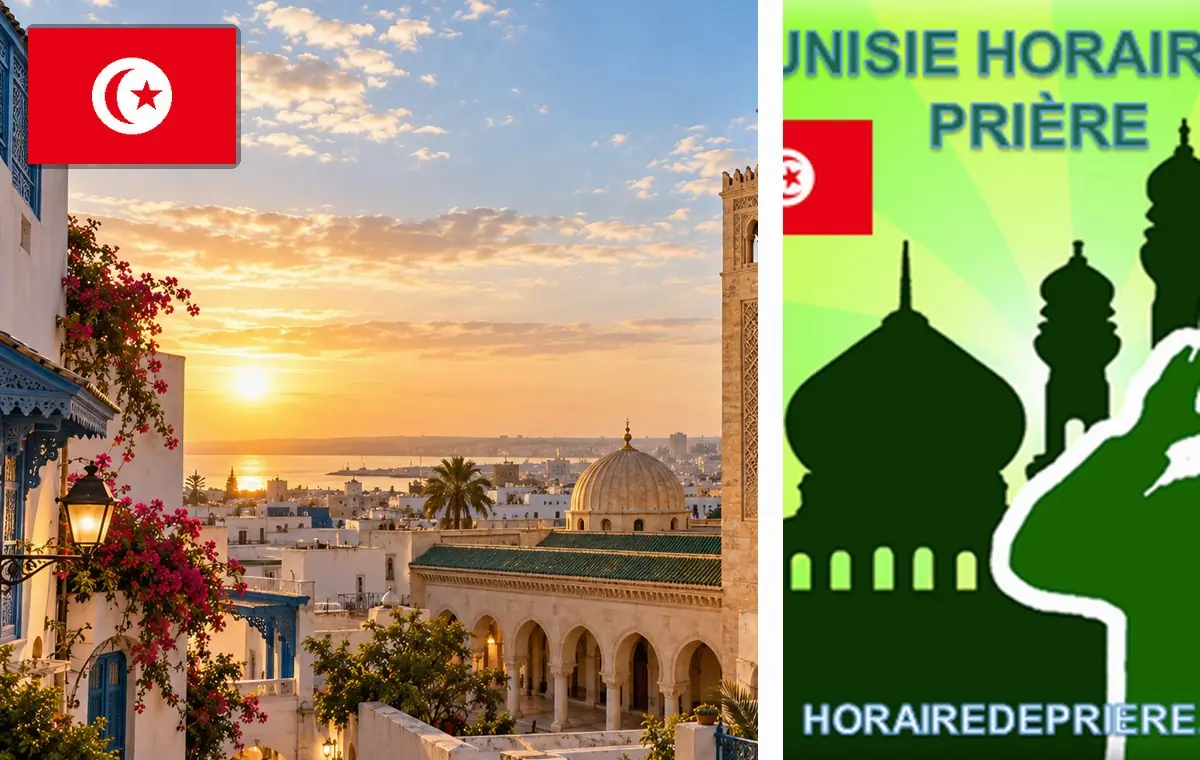
In Tunisia, prayer times are the moments when Muslims across the country perform the five daily prayers: Fajr at dawn, Dhuhr at midday, Asr in the afternoon, Maghrib at sunset and Isha after nightfall. Each is worked out from the position of the sun. The country stretches from the Mediterranean north to the edge of the Sahara and keeps one legal time all year, so the schedule differs by only a few minutes from one city to another, with only minor changes through the year.
A country stretched from north to south
Tunisia extends over more than a thousand kilometres between its northern coast, open to the Mediterranean, and the oases of the Saharan south. This long extent creates clear climate differences: mild weather and rain around Bizerte and Tunis, dry heat towards Tozeur and Tataouine. For prayer it means moderate gaps: days are a little longer in the north in summer and a little shorter there in winter than in the south.
East-west extent and legal time
Narrow from east to west, Tunisian territory produces only a slight solar offset between inland towns such as Le Kef or Kasserine and coastal cities such as Sousse or Sfax. Fajr and Maghrib therefore arrive a few minutes earlier in the east than in the west. The country keeps the same time all year round, with no seasonal clock change, which keeps the reference points steady from month to month.
Main cities and religious life
The Zitouna Mosque, at the heart of the Tunis medina, and the Great Mosque of Kairouan, one of the oldest sanctuaries in the Maghreb, shape the country's religious history. Tunis, Sfax, Sousse, Kairouan and Gabès have many places of worship, where Friday prayer gathers large congregations. In villages and city districts alike, the call to prayer still marks the rhythm of the day, in the cities as well as in the villages, from early morning until night.
Ramadan and Eid in Tunisia
During Ramadan the pace of the country changes: offices and shops close earlier, streets empty as Maghrib approaches, and then cafés and squares fill up after dark. Families prepare traditional dishes to break the fast, and the Tarawih prayers bring together many worshippers. At Eid, family visits and homemade pastries fill the days in every region of the country. Shops reopen in the evening, and many people stay up late until the pre-dawn meal before Fajr begins.
Tunisia prayer times: Frequently asked questions
Does Tunisia change its clocks in summer?
No, the country keeps the same legal time all year. Prayer slots therefore move only with the sun and the seasons, without the one-hour jump seen in Europe each spring and autumn.
Are prayer times the same across the whole country?
Not exactly. Eastern cities receive daylight a few minutes before western ones, and latitude also plays a small part, so a schedule specific to each city remains preferable.
Which great mosques mark the country's religious history?
The Zitouna Mosque in Tunis and the Great Mosque of Kairouan are the best known. Both are major historic buildings of the Maghreb and welcome worshippers for prayer and the main festivals.
Further reading
- IslamicFinder : English-language IslamicFinder page for Tunisia, with today's prayer times, the Qibla direction and a monthly calendar for the capital.