
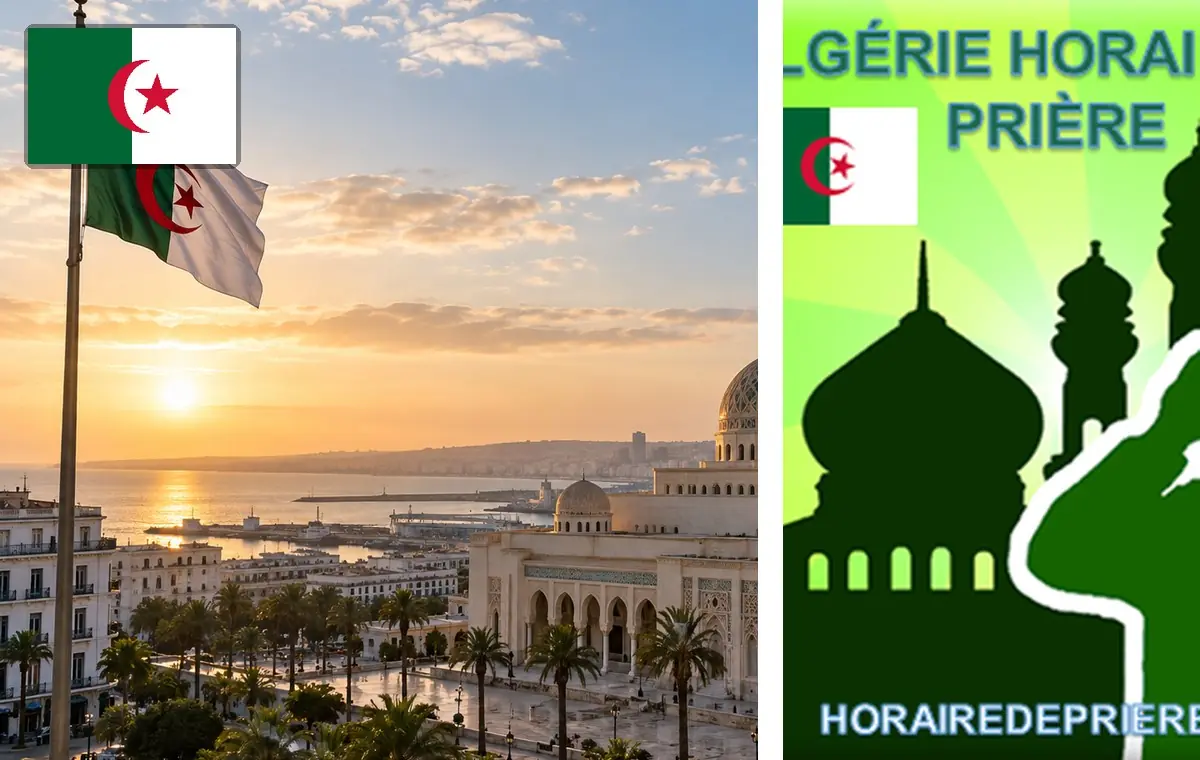
In Algiers, prayer times mark the moments when the five daily prayers, Fajr, Dhuhr, Asr, Maghrib and Isha, fall due according to the sun's position. The Algerian capital rises in tiers above its Mediterranean bay at roughly 36.7 degrees north, so summer days are long and bright while winter days are noticeably shorter. Algeria keeps one standard time all year and does not move its clocks, which means the schedule in Algiers changes only gradually, by a few minutes from one day to the next, following the sun.
Daylight on the Bay of Algiers
Algiers sits on the northern coast of Africa and enjoys plenty of sunshine. In June the day stretches out, Fajr comes early and Maghrib arrives late in the evening. By December the light fades much sooner and the five prayers sit closer together. The sea moderates the temperature, so the seasonal rhythm is smooth and easy to follow. Residents often sense the turn of the seasons from the point on the hills of the Sahel where the sun sets behind the city.
One time zone, no clock changes
Algeria does not change its clocks in spring or autumn. For anyone living between two countries this is convenient, because the prayer schedule in Algiers moves slowly and never jumps overnight. The gap with Europe, however, does change twice a year, which can catch families off guard when they phone relatives. It is wise to confirm local time before a call or a flight, especially around Maghrib, when many households gather for the evening meal during Ramadan.
Mosques and religious life in the capital
The city has a rich religious heritage. The old Casbah holds historic mosques such as Djamaa el-Kebir, among the oldest in Algiers, and the Ketchaoua mosque. The Great Mosque of Algiers, standing by the bay east of the centre, is one of the largest places of worship in Africa and has an exceptionally tall minaret. Working-class districts like Bab El Oued and Belcourt fill up on Fridays, and neighbourhood mosques structure the day for each community around the city.
Ramadan and Eid in Algiers
During Ramadan the capital takes on a different pace. Streets empty shortly before Maghrib, then families gather around soup, savoury pastries and dates before heading to Tarawih. Cafes and markets stay lively late into the night, and working hours are frequently adjusted, with shops opening later in the morning. At Eid, congregational prayers draw large crowds to the main mosques, followed by family visits and traditional sweets shared among relatives and neighbours.
Algiers prayer times: Frequently asked questions
Do clocks change in Algiers?
No. Algeria keeps the same standard time throughout the year, so prayer times in Algiers change only with the sun's position, by a few minutes from one day to the next.
Why do prayer times in Algiers differ between summer and winter?
Day length changes with the seasons. In summer Fajr comes earlier and Maghrib later, while in winter the five prayers are squeezed into a shorter span of daylight.
What is the main mosque in Algiers?
The Great Mosque of Algiers, known as Djamaa el-Djazair, overlooks the bay east of the centre. It is one of Africa's largest mosques, with a very tall minaret.
Further reading
- IslamicFinder : IslamicFinder's page for Algiers, in English, with the day's prayer times and the Qibla direction.