
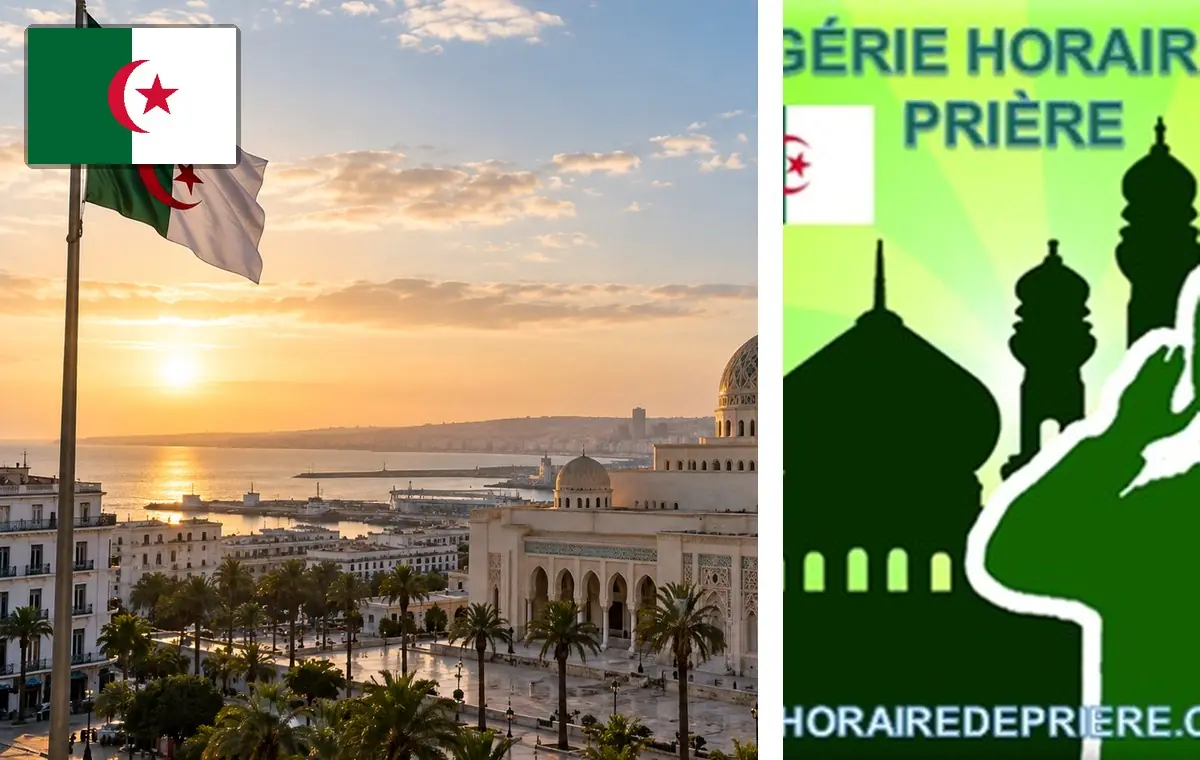
In Algeria, prayer times mark the moments when Muslims perform the five daily prayers: Fajr, Dhuhr, Asr, Maghrib and Isha. Each one is worked out from the position of the sun between dawn and nightfall. Because the country stretches so far from east to west, the sun rises earlier in Annaba than in Tlemcen or Bechar, by a few minutes. The climate, Mediterranean in the north and desert in the south, also shapes the rhythm of the day and the length of the nights.
A huge territory with small sun differences
Algeria is the largest country in Africa by area. Between the Tunisian border in the east and the Moroccan border in the west, the sun does not reach its highest point at the same moment. Someone in Oran sees dawn later than someone in Constantine, even though the whole country keeps one legal time. These gaps explain why timings differ slightly from one province to another, and why it is better to check the city closest to you.
Seasons from the coast to the Sahara
Along the coast, around Algiers, Oran and Bejaia, summer days are much longer than winter ones, which pushes Fajr very early and Maghrib late into the evening. On the High Plateaus winters are cold and dawn arrives in crisp air. In the Sahara, at Ghardaia, Ouargla or Tamanrasset, the afternoon heat leads many people to stay in the shade between Dhuhr and Asr and to resume activities after sunset. Coastal and inland cities therefore rarely share exactly the same minute.
Mosques and religious life in Algeria
Mosques set the pace of neighbourhoods and villages, from the Casbah of Algiers to the ksour of the M'zab. The Great Mosque of Algiers, recently opened on the bay, has one of the tallest minarets in the world. In cities such as Constantine, Tlemcen or Batna, Friday prayer gathers large crowds, and the call to prayer sounds in every municipality. Quranic schools and zawiyas also pass on recitation and memorisation of the sacred text.
Ramadan and Eid in Algeria
During Ramadan the pace of the country changes: shops open later, streets empty as Maghrib approaches, then fill again after taraweeh. Breaking the fast brings families together around chorba, homemade bread and dates. Eid al-Fitr and Eid al-Adha are public holidays, with the morning congregational prayer held in mosques or on large squares, followed by visits to relatives. The pace changes again in the south, where families gather in the cool of the evening after the heat of the afternoon.
Travelling across the country between prayers
Long journeys by national road, train or plane between Algiers, Oran and Tamanrasset often cross the time of a prayer. Service stations, railway stations and airports frequently provide a prayer room. A traveller may combine certain prayers according to recognised custom, but the simplest approach is to check the timings of the city being crossed in advance and plan stops accordingly. Travellers often pray at roadside rest areas on the long desert routes.
Algeria prayer times: Frequently asked questions
Are prayer times the same everywhere in Algeria?
No. The country is very wide from east to west, so the sun rises and sets at slightly different moments in Annaba, Algiers, Oran and Bechar, even though the legal time is identical.
Which five prayers are observed in Algeria?
They are Fajr at dawn, Dhuhr at midday, Asr in the afternoon, Maghrib at sunset and Isha at night, exactly as elsewhere in the Muslim world.
Where can I find timings for a specific Algerian city?
Each city in the list has its own page. Differences with the capital can reach several minutes in the south and the west, which is why choosing your own city matters.
Further reading
- IslamicFinder : English-language IslamicFinder page with the prayer times of Algiers and the calculation method used for Algeria.