
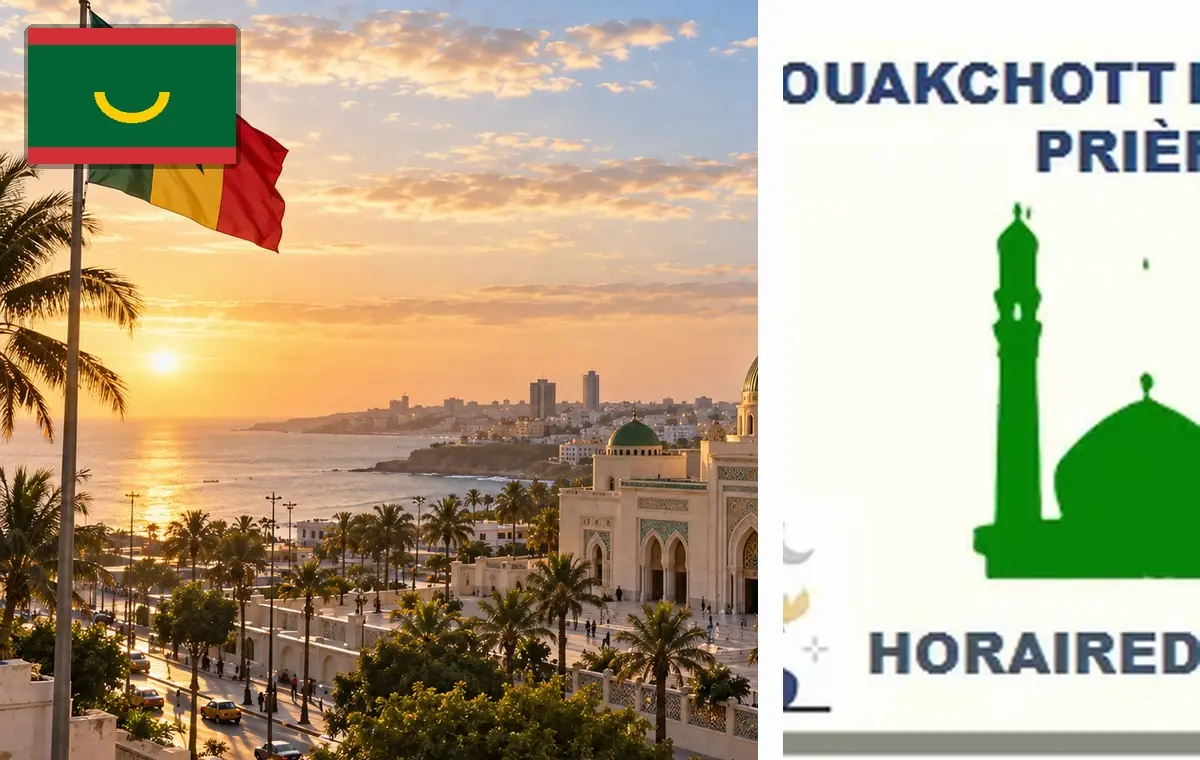
In Nouakchott, prayer times mark the five moments of the day when Muslims perform Fajr, Dhuhr, Asr, Maghrib and Isha, calculated from the path of the sun. The capital of a country where Islam is the state religion, the city stands on the Atlantic coast beside the desert. Its tropical latitude keeps day length almost constant from one season to another, so prayers shift by only a few dozen minutes between winter and summer. It is also a city where the call to prayer from the minarets still structures the day.
A steady sun in the tropics
Nouakchott lies at about eighteen degrees north. At that latitude the day stays close to twelve hours long all year, and sunrise and sunset move very little. Prayers therefore follow a far steadier rhythm than in European capitals. Clear skies, strong midday light and a fairly short twilight make the passage from Maghrib to Isha quick, and darkness settles soon after the sun goes down. People often note that evenings feel almost the same length in January as in July.
Saharan climate and sandstorms
The capital has a desert climate softened by the nearby ocean. Daytime heat is strong, especially in the hot season, while evenings feel milder thanks to the sea breeze. Sand-laden winds can lift dust and veil the sky, leaving the horizon hazy around sunset. Many residents avoid the hottest hours and make the most of the cooler air at dawn and in the evening. Houses and shops are built to keep the heat out, with thick walls and shaded courtyards.
Time zone and religious life in Nouakchott
Mauritania keeps Greenwich time with no seasonal clock change, which makes the daily schedule easy to follow throughout the year. The country is known for its tradition of Islamic learning, inherited from its Quranic schools, the mahadras, and its renowned scholars. In Nouakchott mosques stand in every district, and the Saudi Mosque, with its tall minaret, is among the most visible in the city. Prayer is also central to the week, with the Friday gathering drawing large crowds across the capital.
Ramadan, Eid and the pace of the city
During Ramadan, evening life in Nouakchott comes alive: once the fast is broken, families gather, shops reopen and mosques fill for the tarawih prayers. Because day length varies so little, the fast lasts about the same number of hours whatever season Ramadan falls in. Eid is marked by the communal prayer, family visits and generous sharing among neighbours. Charity is central to the month, and many families prepare meals for people in need.
Daily life and getting around Nouakchott
Nouakchott is a young and fast-growing city, with busy markets, a working port and neighbourhoods that spread out across flat sandy ground. Shops and offices often pause during the hottest hours and reopen later in the afternoon, so the working day follows the same rhythm as the prayers. Visitors arriving by air quickly notice that life slows around midday and revives toward the evening, when the streets fill again with residents and traders.
Nouakchott prayer times: Frequently asked questions
Why do prayer times change so little in Nouakchott?
The city is close to the tropics, so day length stays near twelve hours almost all year. Prayers move by only a few dozen minutes between winter and summer.
Does Mauritania change its clocks?
No. The country keeps the same time all year, aligned with Greenwich. Prayers therefore do not jump by an hour in spring or autumn, unlike in Europe, where the clocks move twice a year.
How does the heat shape the day in Nouakchott?
The early afternoon is the hottest period, especially in the hot season. Many residents rest then and resume their activities around Asr or after sunset, when the air cools down.
Further reading
- IslamicFinder : English-language page with the detailed prayer calendar for Nouakchott.