
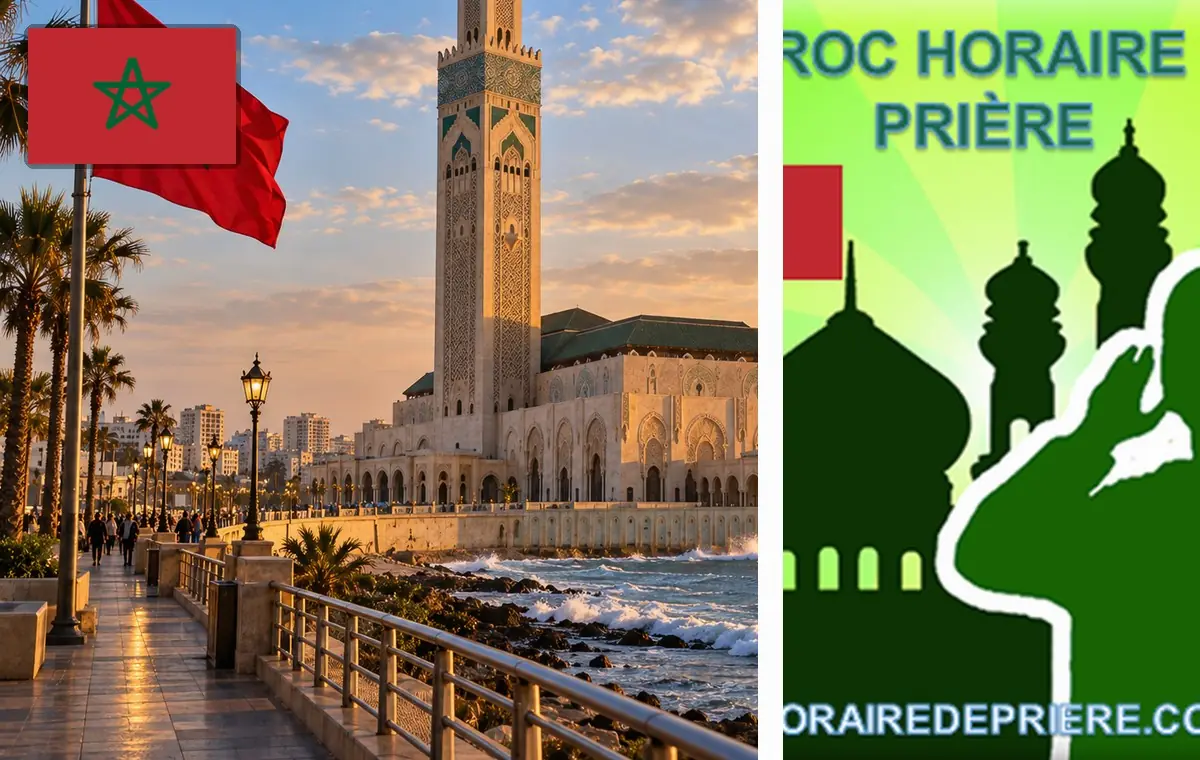
In Morocco, prayer times mark the moments of the five daily prayers, Fajr, Dhuhr, Asr, Maghrib and Isha, calculated from the sun's course across the sky. The kingdom stretches from the Mediterranean and Atlantic coasts to the edge of the Sahara, so sunrise and sunset shift slightly from one region to another. The country uses a single legal time, with an adjustment during the month of Ramadan, and the large cities all follow that same clock throughout the year, whatever the region.
A country that stretches from north to south
Between the Strait of Gibraltar and the Saharan provinces, Morocco spans many degrees of latitude. In the north, summer days are longer and winter days shorter than in the south, where day length varies less. This extent explains why the schedule of Tangier, Marrakech and Dakhla never matches exactly. People therefore check the calendar of their own town, because each locality has its own position relative to the sun. This matters for daily planning.
From the Atlantic coast to the Atlas and the east
Moroccan geography alternates an Atlantic seaboard, the Atlas ranges, inland plains, oases and eastern regions close to Algeria. The further east one goes, as in Oujda, the earlier the sun rises; the further west towards the Atlantic, the later it rises. These gaps are modest, a few minutes, but they matter for Fajr and Maghrib. In the mountains, relief can also delay the arrival of sunlight in deep valleys, which makes mornings feel later there.
Morocco's legal time and the month of Ramadan
Morocco keeps an advanced legal time for most of the year, which returns to standard time during Ramadan before resuming afterwards. This rule shifts the landmarks of daily life, especially the moment of breaking the fast and the working hours. The time of Maghrib, however, stays tied to the sun and not to the clock. Travellers arriving from Europe should therefore check the time zone gap for the period of the year in which they travel.
Mosques, historic cities and religious traditions
Moroccan religious life rests on a very large number of mosques, from the humblest to those of Casablanca, Rabat and Fez, where the famous Qarawiyyin university is a historic landmark. The call to prayer rings out five times a day in old medinas and modern districts alike. On Friday, shops slow down at the hour of congregational prayer. For Ramadan and the two Eids, families, neighbourhoods and villages gather around shared meals and customs.
Morocco prayer times: Frequently asked questions
Are prayer times the same across Morocco?
No, they vary by a few minutes from one city to another depending on longitude and latitude. Rabat, Fez, Marrakech and Agadir each have slightly different times for the five prayers.
Does Morocco's legal time change during Ramadan?
The country returns to standard time during the month of Ramadan, then resumes advanced time. The prayers themselves remain set by the sun, which avoids any confusion with the clock.
How are prayers determined in Morocco?
They rely on the position of the sun: Fajr at dawn, Dhuhr after the zenith, Asr by shadow length, Maghrib at sunset and Isha at nightfall, using the locally adopted method.
Further reading
- IslamicFinder : English-language page for Morocco, centred on the capital Rabat, showing the five daily prayer times.