
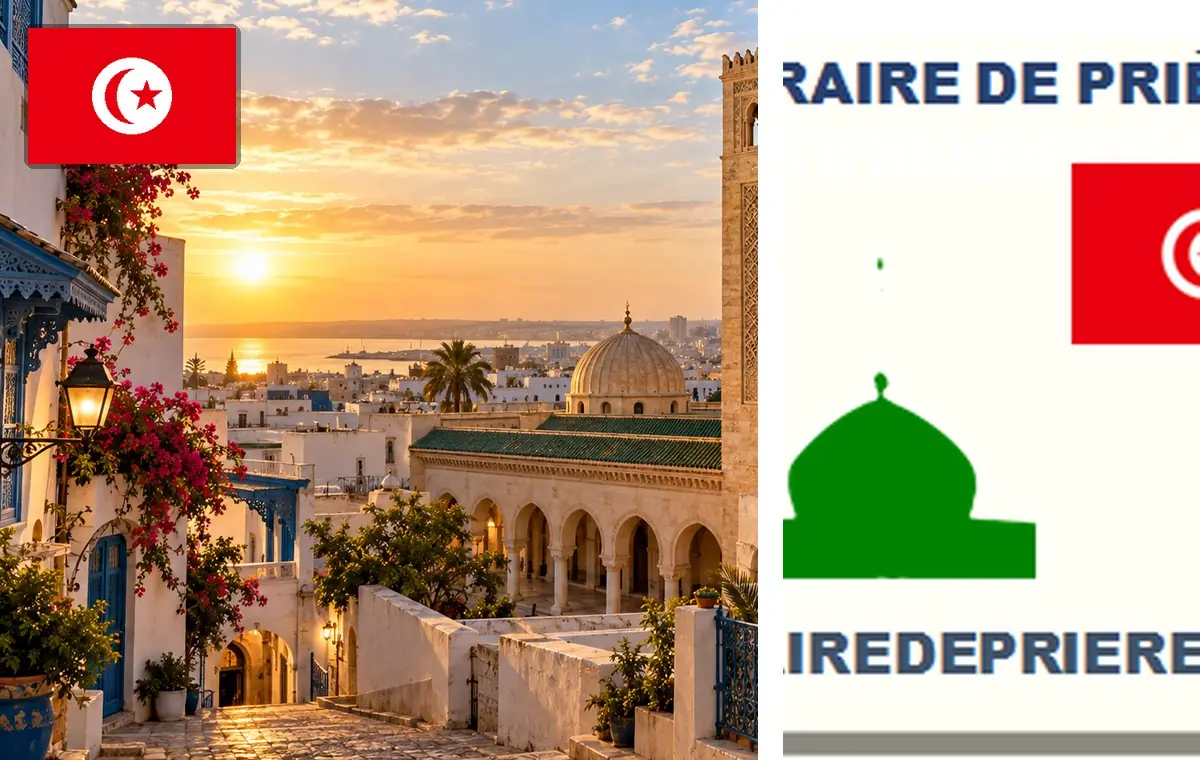
In Tunis, prayer times set the five daily appointments of Fajr, Dhuhr, Asr, Maghrib and Isha, calculated from the position of the sun above the gulf. The Tunisian capital sits on the Mediterranean coast at a middle latitude, which gives longer days in summer and shorter ones in winter without extremes. The city keeps the same legal time all year, with no seasonal clock change, and the muezzin's call rises from the medina to the modern districts alike. The call to prayer is a familiar part of the soundscape.
A Mediterranean gulf and contrasting seasons
Tunis opens onto the gulf and the lake that borders the city. Summers are hot and dry, with long evenings when Maghrib arrives late, while winters are mild but sometimes rainy. Differences in day length stay moderate compared with countries further north, so the prayer calendar is fairly regular, with an early Fajr in summer and an early Maghrib in December. Even so, the rhythm of daily life follows the sun closely from one season to the next.
A legal time that stays the same all year
Tunisia keeps one time throughout the year and does not move to summer time. Prayer times therefore change only with the course of the sun, never because of a clock shift. For a resident of Tunis this simplifies following the calendar, whereas visitors from Europe sometimes need to adjust their watch depending on the season they leave in. These seasonal changes are gentle compared with those of northern Europe, and easy to follow with a calendar.
The medina of Tunis and its mosques
The religious heart of the city is the medina, a World Heritage site, where the Zitouna Mosque stands, one of the great centres of learning in Maghrebi Islam. Alleys, souks and former zawiyas surround this core. Further out, districts such as La Marsa, Bardo or Ariana each have neighbourhood mosques where Friday prayer gathers families of all ages. Neighbourhood mosques stay open late during the holy month, and many fill up well before the evening prayer.
Ramadan and Eid in Tunis
During Ramadan Tunis changes its face: cafes close by day, markets fill before sunset and tables for breaking the fast are laid around soup, brik and dates. Evenings stretch on in the medina after taraweeh. At Eid al-Fitr, as at Eid al-Adha, families attend the congregational prayer and then visit one another. The late evenings are full of life, with families, friends and neighbours meeting in cafes once the fast is over.
Getting around between Tunis, Carthage and the rest of the country
The light rail, the TGM train to Carthage and La Marsa, and taxis shape daily journeys in the capital. Trips towards Sousse, Sfax or Bizerte may cross the time of a prayer. Service stations and bus stations often provide a prayer space, and the sun's difference between Tunis and the south of the country is only a few minutes. Prayer rooms in major hubs are a practical help for those moving between cities.
Tunis prayer times: Frequently asked questions
Does Tunis change its clocks in summer?
No. Tunisia keeps the same legal time all year. Prayer times follow the sun alone, without the one-hour shift that European countries experience. It simplifies planning.
Do seasons change prayer times much in Tunis?
Yes, though moderately. Days are longer in summer, with an early Fajr and a late Maghrib, and shorter in winter, without extreme gaps. Nothing special is needed.
What is the historic great mosque of Tunis?
It is the Zitouna Mosque, in the heart of the medina. It is among the oldest and most important places of worship and religious teaching in Tunisia. It remains a place of study today.
Further reading
- IslamicFinder : English-language IslamicFinder page with the prayer calendar for Tunis and its calculation settings.