
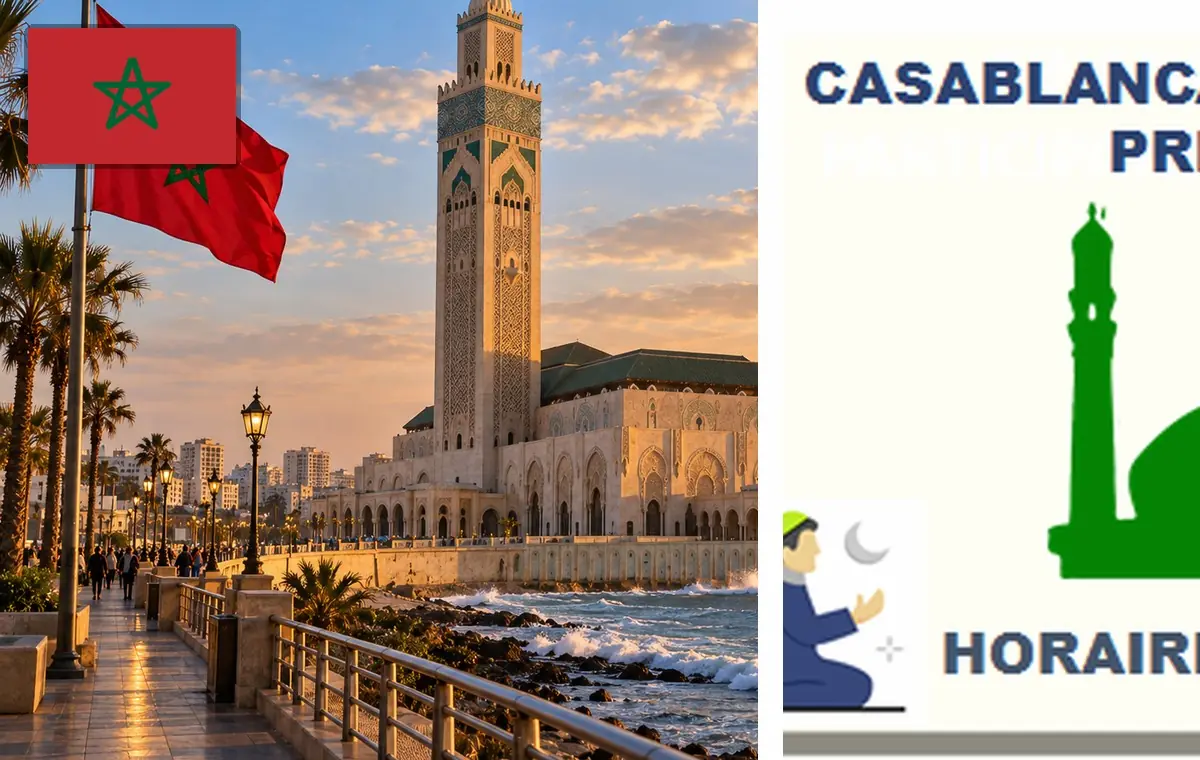
In Casablanca, prayer times mark the five daily prayers, Fajr, Dhuhr, Asr, Maghrib and Isha, each worked out from the position of the sun above the city. Standing on Morocco's Atlantic coast, Casablanca has days that lengthen and shorten gently through the year, so dawn and sunset drift by a few minutes every week. The kingdom's sprawling economic capital keeps one common clock across all its districts, giving residents, commuters and visitors the same reference points from the old medina to the coastal suburbs.
Casablanca's Atlantic light through the seasons
Casablanca sits on the Atlantic shore at a latitude of roughly thirty-three degrees north. Daylight changes in a mild, predictable way: summer evenings stretch out, winter days close earlier, yet the contrast never approaches that of northern Europe. Fajr often arrives under a sea mist drifting in from the ocean, while Maghrib is watched by many from the seafront corniche as the sun drops toward the horizon. This steady cycle helps people anticipate each prayer from one season to the next.
The Hassan II Mosque and local places of worship
Religious life in Casablanca is closely tied to the Hassan II Mosque, built on the edge of the ocean and crowned by one of the tallest minarets in the world. It draws worshippers and visitors alike, but the city also holds countless neighbourhood mosques, from the old medina to residential districts. Each quarter has its familiar mosque where the call to prayer punctuates the day and where people gather for the congregational prayer every Friday.
Prayer in a busy economic capital
As Morocco's commercial heart, Casablanca moves at a brisk pace, with city-centre offices, a major port, industrial zones and universities. Many employees plan Dhuhr around the midday break, while Asr falls in the late afternoon, ahead of the evening traffic. The tramway and the wide boulevards shape daily journeys, and people adjust their routes so as not to miss Maghrib. Traders, students and office workers each arrange their prayers around their own timetable.
Ramadan and Eid in Casablanca
During Ramadan the city takes on a different character: streets empty shortly before Maghrib, then fill again once the fast is broken, with tables laden with harira soup, dates and honey pastries. The fast runs from dawn, marked by Fajr, until sunset. Nights are punctuated by Tarawih prayers in the mosques, and Eid brings families together in traditional dress for visits, congregational prayers and shared meals. Many neighbourhoods also organise charity meals and food distribution during the month, a tradition that gives the city a strong sense of solidarity.
Casablanca prayer times: Frequently asked questions
Which five prayers are observed in Casablanca?
Fajr at dawn, Dhuhr around midday, Asr in the afternoon, Maghrib at sunset and Isha once night has fallen. Their exact moments follow the sun and shift gradually with the seasons.
Do prayer times in Casablanca change much during the year?
Yes, but gradually. Casablanca lies at a temperate latitude, so dawn and sunset move by a few minutes each week, which is why checking the daily timetable works better than relying on a fixed reference.
Where can I join the Friday prayer in Casablanca?
Neighbourhood mosques across the city hold the Friday congregational prayer, and the Hassan II Mosque is the best known building for anyone who wishes to go there.
Further reading
- IslamicFinder : IslamicFinder page for Casablanca with the day's prayer times for the city (page in English).