
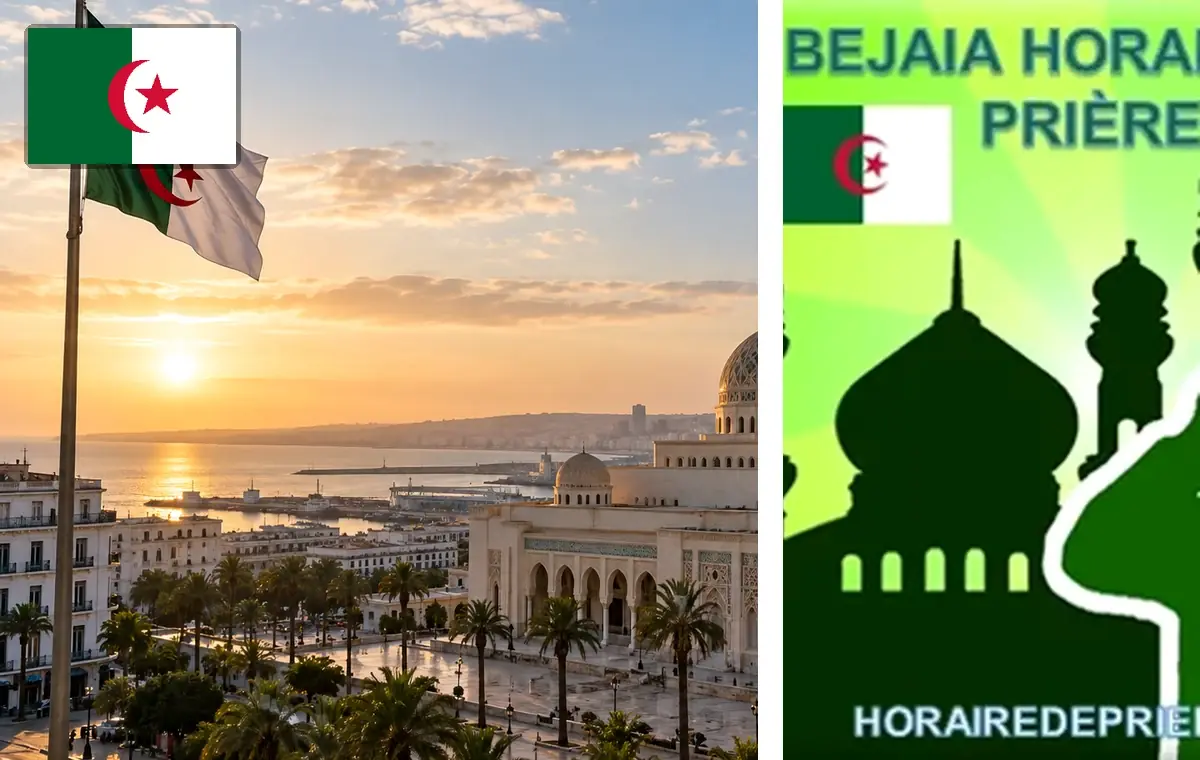
In Bejaia, prayer times are the moments set for the five daily prayers of Muslims: Fajr, Dhuhr, Asr, Maghrib and Isha. They are worked out from the position of the sun above the local horizon, so they shift slightly from one day to the next. On this port city of the Kabyle coast, open to the Mediterranean and backed by mountains, the light of dawn and dusk depends on both relief and sea. Long summer days and shorter winter days move Fajr and Isha noticeably across the year.
Bejaia between gulf and mountain
The Gulf of Bejaia opens onto the Mediterranean, while the Gouraya massif and its national park rise above the city. This geography shapes daily life, with sea breezes, humidity and light that changes through the day. For prayer, the schedule is calculated for the whole city from its coordinates, not neighbourhood by neighbourhood. People living near the centre, the harbour or the hillsides therefore notice only small differences, mostly at dawn and dusk, when the relief hides or reveals the horizon a little earlier.
Seasons and day length on the Kabyle coast
The Mediterranean climate brings hot, bright summers and mild, rainy winters. In summer the sun rises early and sets late, so Fajr comes early and Isha comes late, which shortens the night between them. In winter the day contracts, Maghrib moves closer to the afternoon and the night stretches out. This steady rhythm is why worshippers rely on an up-to-date calendar rather than remembering fixed reference points from one season to the next.
Religious life and mosques in the city
Bejaia has a long Muslim history. Under the Hammadids the city became a centre of learning and trade, drawing scholars from across the Mediterranean. Today mosques still set the pace of neighbourhood life, from Friday gatherings to the daily prayers. University students, harbour traders and families from nearby villages share the same moments of the day. The call to prayer therefore organises journeys, work breaks and meetings, in the town itself as well as in the Soummam valley.
Ramadan and Eid in Bejaia
During Ramadan, prayer times become the thread of the whole day: Fajr marks the start of the fast and Maghrib its breaking. The city changes pace, with shops open late in the evening and gatherings after Isha and the Tarawih prayers. Families prepare traditional regional dishes for iftar. Eid al-Fitr and Eid al-Adha are celebrated with relatives and neighbours, in an atmosphere where the morning prayer brings together a large number of worshippers.
Bejaia prayer times: Frequently asked questions
Do prayer times change during the year in Bejaia?
Yes, they vary every day with the sun's path across the sky. The gap is most visible between summer and winter, especially for Fajr, Maghrib and Isha.
Do the mountains around Bejaia change sunset?
Nearby mountains can make dusk seem slightly earlier in some districts, but the prayer calculation relies on the sun's position for the city as a whole.
Which time zone does Bejaia follow for prayer?
Bejaia follows Algeria's standard time, which stays the same all year. There is no daylight saving change, so the reference points remain steady from month to month.
Further reading
- IslamicFinder : IslamicFinder page for Bejaia with the city's daily prayer times (the page is in English).