
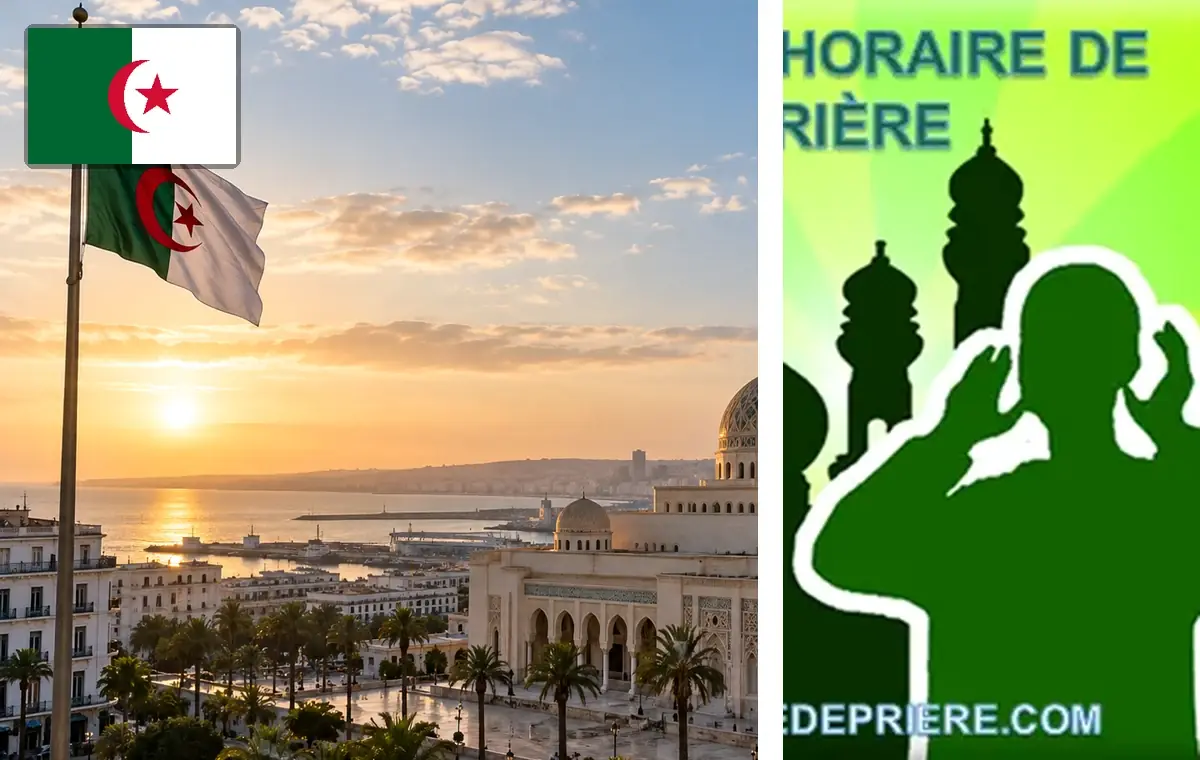
In Skikda, prayer times mark the day through the five obligatory prayers: Fajr before sunrise, Dhuhr at midday, Asr in the afternoon, Maghrib at sunset and Isha at night. They are worked out from the sun's course, not from a fixed daily schedule. A Mediterranean port in north-eastern Algeria, Skikda faces the sea at the head of the Gulf of Stora, with wooded hills rising behind it. A humid climate, rainy winters and warm summers softened by sea breezes shape how each day unfolds.
Between sea and hills in Skikda
The city spreads along the Mediterranean at roughly thirty-seven degrees north. The sea opens a clear view to the north, while nearby hills and the Collo massif can delay the first sunlight slightly in some districts. Summer days are long and winter days much shorter, so Fajr in December comes well over an hour later on the local clock than Fajr in June. The coastal position also keeps temperatures moderate, so long summer daylight feels less punishing than in inland Algeria.
Rain, humidity and port life
Winter brings heavy showers and overcast skies that hide the sun, although the timings themselves rest on astronomical calculation. The port and the neighbouring industrial zones, notably petrochemicals, employ many shift workers who arrange their breaks around prayer. Algeria does not move its clocks during the year: only the length of daylight shifts the schedule from one season to the next, with no sudden jump in spring or autumn. Sea air keeps humidity high even in warm months.
History and mosques of Skikda
Founded in the nineteenth century as Philippeville beside the remains of ancient Rusicade, the city regained its present name after independence. Its grid of streets, squares and older buildings now stands beside neighbourhood mosques, where Friday prayer brings residents together. Local associations run Quran classes and religious gatherings, often in the evening, once work or study is over. Visitors interested in the city's past often combine a walk through the old centre with time at the shore.
Ramadan, Eid and travel around Skikda
During Ramadan, Skikda's evenings come alive along the seafront and in the markets, where people buy pastries and food for the evening meal. In summer, beaches such as those near Stora draw many visitors, and families plan outings around prayer. At Eid, people travel to Constantine or Annaba, nearby cities where the difference in timings is only a few minutes. Those heading west toward Jijel or Algiers notice the gap widening a little, always tied to longitude.
Skikda prayer times: Frequently asked questions
How are prayer times worked out in Skikda?
They are calculated from the sun's position above the Skikda horizon, taking its latitude and longitude into account. The result shifts slightly each day as the seasons change.
Does rain change the timing of prayers?
No, clouds and rain hide the sun but do not move the timings, which rest on astronomical calculation. A rainy winter in Skikda therefore changes nothing about when each prayer begins.
Are Skikda and Algiers on the same schedule?
Not exactly, but the gap is small. Skikda lies further east, so the sun rises and sets there a little earlier than in the capital, by only a few minutes.
Further reading
- IslamicFinder : IslamicFinder page for Skikda with the day's prayer times, in English.