
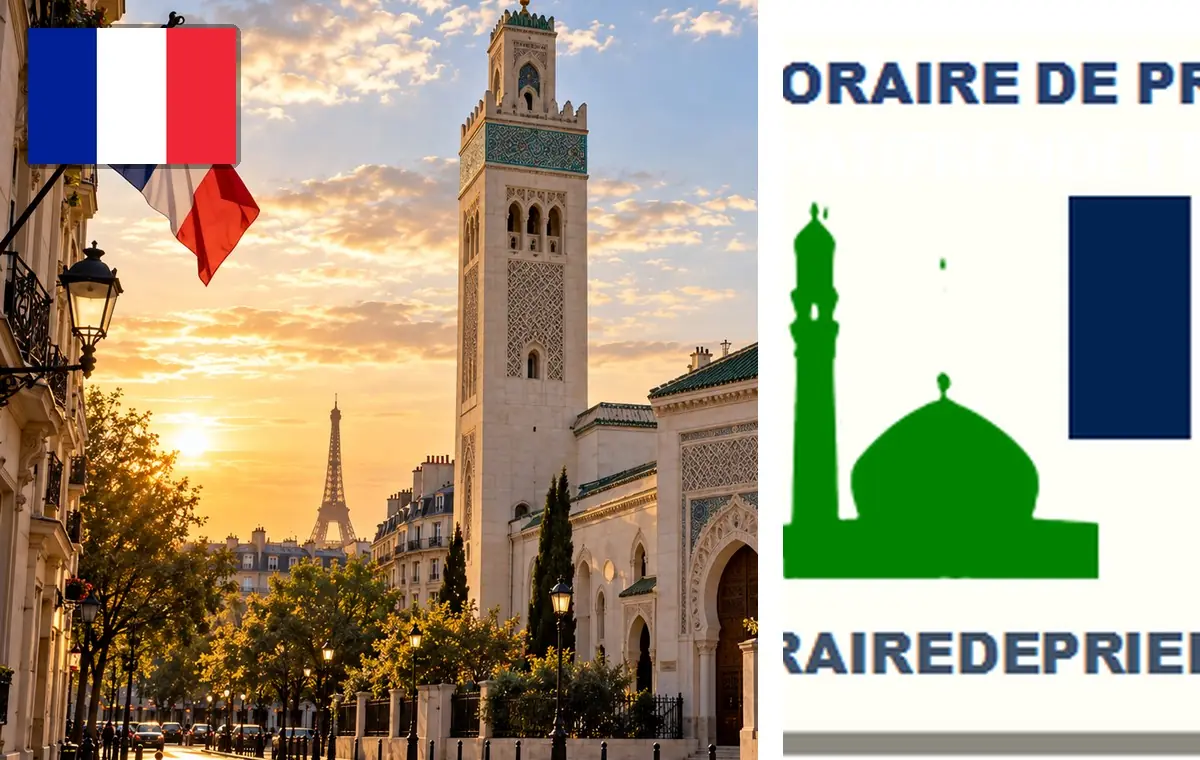
In Paris, prayer times refer to the five daily Muslim prayers: Fajr at dawn, Dhuhr at solar noon, Asr in the afternoon, Maghrib at sunset and Isha at nightfall. They are calculated from the sun's path above the capital. Because Paris lies at a northern latitude, the length of the day varies strongly across the year, and France alternates between winter and summer time, which moves the displayed schedule by one hour twice a year. Each season therefore brings its own timetable to the city.
Paris latitude and the length of the day
Paris sits at roughly forty-nine degrees north. That position explains the dramatic gaps between seasons: in December the sun sets early in the afternoon, while around the summer solstice daylight stretches deep into the evening. Fajr and Isha draw very close together at that time because the night stays short and the sky remains bright for hours. Worshippers in the city therefore follow the weekly changes carefully. The pattern repeats every single year.
Daylight saving time and its effect
The clocks in France go forward in late March and back in late October. On the day of the switch every reference point shifts by an hour on the clock, even though the sun itself has not moved. Early risers in Paris notice the change mostly around Fajr, which suddenly seems to arrive much earlier or later in the night. Smartphones usually update on their own.
Mosques and communities around Paris
Paris hosts one of the largest Muslim communities in Europe, with roots in North Africa, sub-Saharan Africa, Turkey and the Middle East. The Grand Mosque of Paris, in the fifth arrondissement beside the Jardin des Plantes, is among the best-known places, with its minaret and garden. Many community prayer rooms complete the picture in the city's districts and suburbs, fitting around everyday commuting. Opening hours differ from one place to another.
Work, metro and prayer in the capital
In a metropolis where journeys are long, organisation matters. Between the metro, the RER and office or university schedules, people try to place Dhuhr and Asr during a break or a commute. In winter these two prayers sit close to the end of the day, which sometimes makes planning easier. In summer the gap widens and Maghrib comes late, well after most people leave work. Each season therefore brings its own organisation.
Ramadan and Eid in Paris
When Ramadan falls in summer, fasting days are long in Paris and the meal after sunset comes late in the evening; in winter they are far shorter. In districts such as Belleville, the Goutte-d'Or or nearby Saint-Denis, the atmosphere changes noticeably after Maghrib, with shared meals and Tarawih prayers. At Eid, families gather and mosques welcome very large crowds. The month of fasting has a distinct character here. Evenings feel lively.
Paris prayer times: Frequently asked questions
Why do Fajr and Isha come so close in summer in Paris?
At this latitude the sun dips only slightly below the horizon around the summer solstice. Nights are short, twilight lingers and the gap between Isha and Fajr narrows considerably.
Does the clock change alter prayer times in Paris?
The sun does not change, but the clock moves forward or back by one hour. Times shown for Paris therefore shift by an hour on the day summer or winter time begins.
Where is the Grand Mosque of Paris?
It stands in the fifth arrondissement, near the Jardin des Plantes, in the heart of the Latin Quarter. It is served by the metro and usually welcomes visitors during the day.
Further reading
- IslamicFinder : IslamicFinder page, in English, showing the daily prayer times for Paris.