
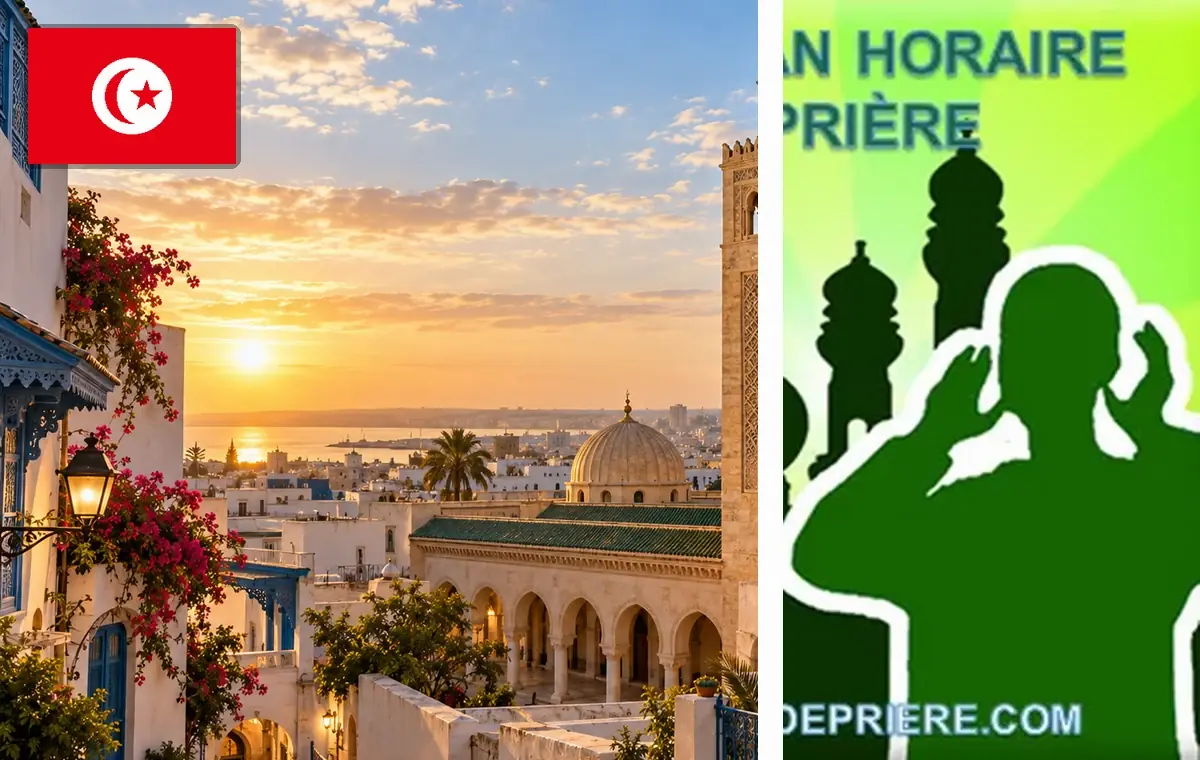
In Kairouan, prayer times set out the five daily Muslim prayers, Fajr, Dhuhr, Asr, Maghrib and Isha, according to the sun's position over the city. Founded in the earliest days of Islam in North Africa, this city in central Tunisia is regarded as one of the holy cities of Muslim tradition. It lies on an inland plain far from the sea, where the horizon is wide and the sky is often clear. The Great Mosque, the walled medina and a semi-arid climate give the place its character.
Kairouan, a holy city on an inland plain
Kairouan stands in the heart of Tunisia, on an open plain ringed by steppe. Founded by Uqba ibn Nafi during the early Muslim conquest of North Africa, it became a major centre of learning and devotion. Its medina, enclosed by brick ramparts, is a UNESCO World Heritage site. Whitewashed lanes, old gateways and the Aghlabid water basins recall the role the city played for centuries. Pilgrims and students have long visited it.
A semi-arid climate and the length of the day
Far from the coast, Kairouan has a semi-arid climate: very hot, dry summers and cool winters with irregular rainfall. Its middle latitude brings longer days in summer and shorter ones in winter, a clear but moderate difference. The open inland sky makes sunrise and sunset easy to read. Tunisia keeps the same legal time all year, so prayer times drift only with the sun's course rather than with clock changes. Winds can rise in summer.
The Great Mosque and local religious life
The Great Mosque, also known as the Mosque of Sidi Uqba, dominates the spiritual life of Kairouan. Its spacious courtyard, massive minaret and prayer hall of many columns count among the oldest religious buildings in North Africa. It stands alongside the Mosque of the Three Doors and numerous shrines of saints. Worshippers gather there for Friday prayer, and visitors also come to admire the architecture while respecting the setting. Calls to prayer echo through the old streets.
Ramadan, Eid and the Mawlid in Kairouan
During Ramadan the medina comes alive in the evening around pastry stalls and markets, especially for makroud, the city's semolina and date speciality. Families gather to break the fast and then head to the mosque for the night prayers. Kairouan is also known for the fervour of its Mawlid celebrations, marking the birth of the Prophet, with religious chanting, night vigils and large gatherings of pilgrims from across the country. Sweet stalls stay open late.
Kairouan prayer times: Frequently asked questions
Why is Kairouan called a holy city?
It was one of the first great centres of Islam in North Africa, and its Great Mosque, its saints and its teaching made it a place of pilgrimage and learning across the region.
Do prayer times in Kairouan change with daylight saving time?
No. Tunisia keeps the same legal time all year, so prayer times shift only with the seasons, without a sudden jump caused by a clock change.
Can visitors enter the Great Mosque of Kairouan?
The courtyard and exterior are generally open to visitors, with respect for the setting and prayer hours, while access to the prayer hall is more restricted. It is best to ask on site.
Further reading
- IslamicFinder : Today's prayer times for Kairouan, calculated for central Tunisia (this site is in English).