
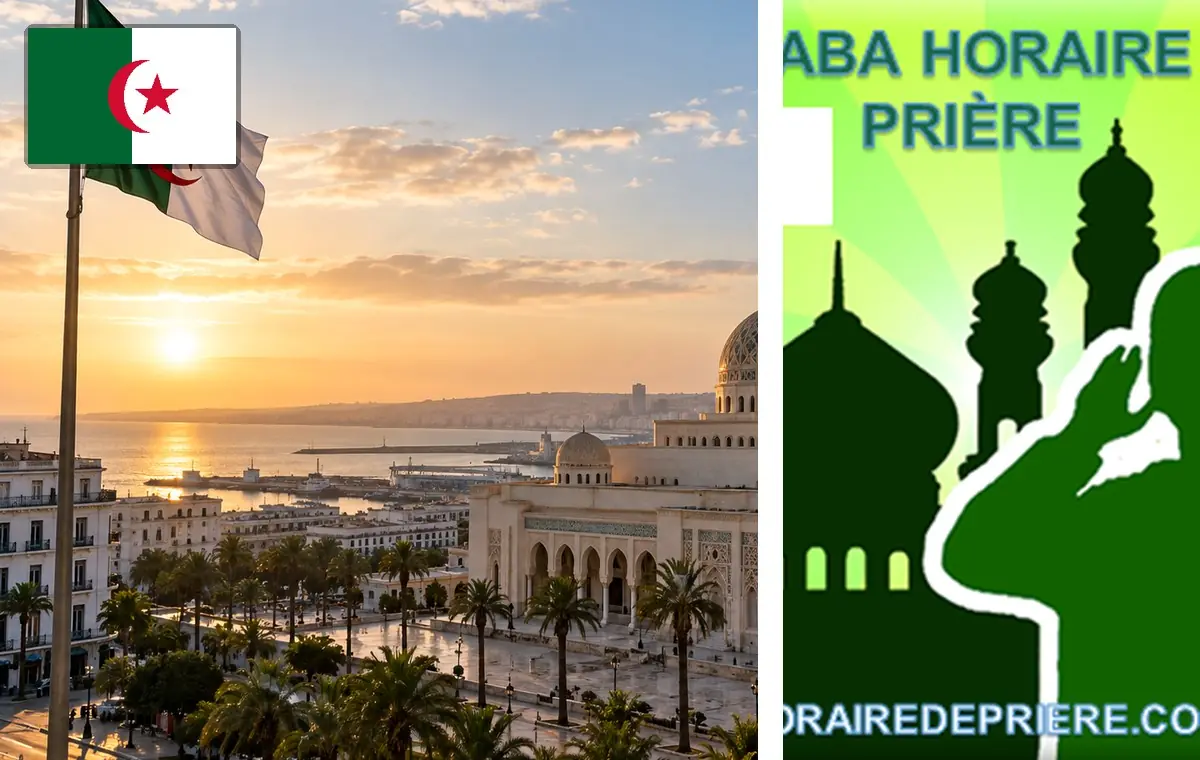
In Annaba, prayer times mark the moments when Muslims perform the five daily prayers: Fajr at dawn, Dhuhr at midday, Asr in the afternoon, Maghrib at sunset and Isha after nightfall. Each one is calculated from the sun's position above the local horizon. This large Mediterranean port in eastern Algeria follows the national clock, and its schedule shifts gently from one season to the next, with long summer days, noticeably shorter winter ones and a sea horizon that makes sunset easy to see.
Annaba between sea and hills
Annaba lies in the far northeast of Algeria, not far from the Tunisian border, around a wide bay and at the foot of the forested Edough massif. The climate is Mediterranean, with mild, rainy winters and hot summers that can feel humid. Because the city opens onto the sea, the western sky is often clear, which makes sunset easy to observe from the seafront and from the higher districts, where many residents like to gather at the end of the day.
Day length across the seasons
Sitting at a latitude close to thirty-seven degrees north, Annaba sees a clear contrast between seasons. In summer the day stretches out, Fajr comes very early and Isha falls late in the evening. In winter the day shortens, Maghrib arrives early and the gap between Dhuhr and Asr narrows. These swings are why residents check the schedule regularly instead of relying on fixed habits, especially when one season gives way to the next.
Faith and heritage in Annaba
Annaba is among the oldest cities in Algeria. The ruins of Hippo, where Saint Augustine once lived, still overlook the bay. Muslim residents attend many mosques, from the old centre to the residential districts, and Friday prayer draws large congregations. The call to prayer punctuates the day, from the lanes near the port to the neighbourhoods surrounding the university, which plays a big part in daily life, and where students also gather to pray.
Ramadan and Eid in Annaba
During Ramadan the city takes on a different rhythm. Maghrib marks the end of the daily fast, families gather, and many people stroll along the Cours de la Révolution, the best-known avenue in the centre. After Isha, the Tarawih prayers fill the mosques. At Eid, family visits and traditional pastries animate the neighbourhoods while the port, the nearby industrial area and the shops slow down for a few days before activity picks up again.
Annaba prayer times: Frequently asked questions
Which five prayers are observed in Annaba?
Residents observe Fajr, Dhuhr, Asr, Maghrib and Isha. Their timing follows the sun over Annaba and moves slightly every day throughout the year, with no fixed pattern from one week to the next.
Why does Fajr move so much in Annaba?
The city sits at a mid latitude, so day length differs sharply between summer and winter. That shifts dawn and dusk by several dozen minutes across the year, which is easy to notice.
Does Annaba use Algeria's standard time?
Yes, it applies the single national time zone. Prayer times are expressed in that clock, with no regional offset, even though the city lies close to the eastern border with Tunisia.
Further reading
- IslamicFinder : English-language IslamicFinder page for Annaba, with today's prayer times, the Qibla direction and a monthly calendar.