
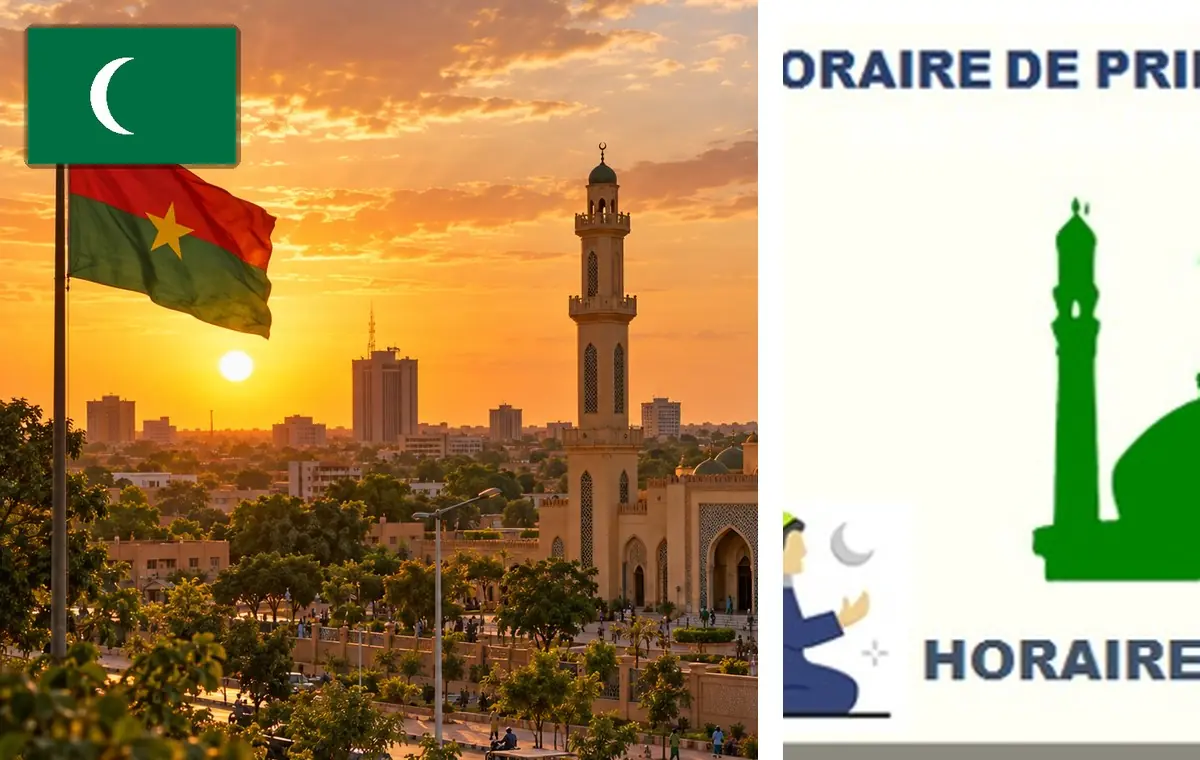
In Ouagadougou, prayer times set the five daily appointments of Muslim worship: Fajr, Dhuhr, Asr, Maghrib and Isha, each calculated from the sun's position. As the capital of Burkina Faso, the city sits in the centre of the country at roughly twelve degrees north, in a Sahelian zone where day length hardly changes through the year. The country follows universal time with no daylight saving, so the prayers move only by a few moments from one day to the next.
Latitude and near-equal days in Ouagadougou
Much closer to the equator than any European city, Ouagadougou enjoys days that stay close to twelve hours in every season. The sun rises early and sets early, which keeps Fajr near dawn and Maghrib in the early evening almost all year. This steadiness contrasts with northern countries, where summer stretches the day. It makes it easier to plan work, study and errands around the five daily prayers. Markets and workshops adapt easily to this steady pattern.
Dry season, harmattan and rains
The Sahelian climate alternates between a long dry season, with the harmattan, a dry and dusty wind from the Sahara, and a rainy season running roughly from June to September. The hottest weeks, before the first rains, make the Dhuhr and Asr prayers especially tiring, and worshippers look for the shade of courtyards and awnings. During the rains, storms can slow the journey to the mosque. Early morning and late afternoon are the most comfortable moments for outdoor activity.
The Grand Mosque and religious life in the capital
Ouagadougou is home to the Grand Mosque, a central landmark for Friday prayer, along with many neighbourhood mosques. The Muslim community, strongly present in Burkina Faso, lives alongside Christian communities and followers of traditional beliefs in a coexistence often held up as an example. Quranic schools and religious associations animate the districts, and the streets around the mosques fill at midday on Fridays. Smaller prayer rooms in markets and offices also serve those who cannot reach a large mosque in time.
Ramadan, Eid and travel from Ouagadougou
Because days are of equal length, the Ramadan fast lasts about the same whatever the season, from dawn until nightfall. The fast is broken at the Maghrib call, often with dates, porridge or local drinks shared among neighbours. Eid brings collective prayer, new clothes and visits. A traveller arriving from Paris will notice that local time runs one or two hours behind, depending on the season. Families often travel to relatives in villages for the holiday.
Ouagadougou prayer times: Frequently asked questions
Do prayer times vary much in Ouagadougou?
Very little through the year, because the city lies near the equator and its days stay close to twelve hours. The prayers shift by only a few minutes between seasons.
Does Burkina Faso change its clocks?
No, the country stays on universal time all year. In Ouagadougou no daylight saving shifts the prayers, which follow only the sun's course across the sky.
Where can I attend Friday prayer in Ouagadougou?
Worshippers go to the Grand Mosque or to one of the many neighbourhood mosques. The collective Friday prayer takes place around midday, after the sermon.
Further reading
- IslamicFinder : Ouagadougou page with the daily prayer schedule and the Qibla direction (page in English).