
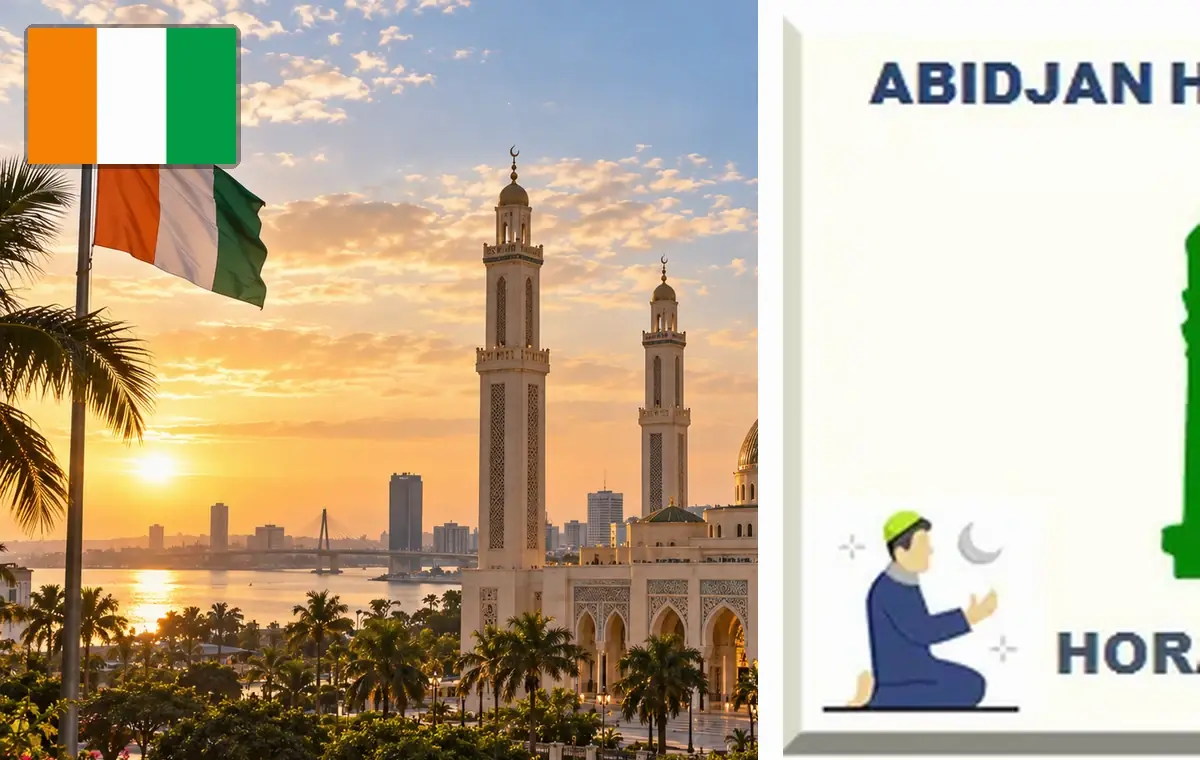
In Abidjan, prayer times mark the five daily prayers, Fajr, Dhuhr, Asr, Maghrib and Isha, each worked out from the sun's position over the city. Sitting on the Gulf of Guinea about five degrees north of the equator, Ivory Coast's economic capital has days of almost constant length. Seasonal differences are therefore small and the timings drift only slightly from one month to the next. The city keeps Greenwich Mean Time all year round, with no seasonal clock change to adjust for.
A steady sun near the equator
Because Abidjan lies so close to the equator, daylight around the Ebrié Lagoon lasts roughly twelve hours in every season. Sunrise, which anchors Fajr, and sunset, which marks Maghrib, shift by only a few minutes across the year. That stability makes daily planning easier for people who build their routines around prayer. Twilight is brief because the sun drops almost vertically below the horizon, keeping Maghrib and Isha close together.
Climate and rainy seasons in Abidjan
The climate is hot and humid, with a main rainy season from May to July and a shorter one in October and November. During downpours heavy cloud hides the sun, yet the astronomical calculation behind each prayer time is unaffected. From December to February the harmattan, a dry wind from the Sahara, brings a dusty haze that can blur the dawn. Worshippers then rely on the calculated timings rather than on the look of the sky.
Religious life across Abidjan's districts
Abidjan is home to a large Muslim community spread across districts such as Abobo, Adjamé, Yopougon, Treichville and Plateau. Neighbourhood mosques issue the call to prayer five times a day, and Friday congregations fill many of them. Traders, office workers from the business district and students live alongside families settled here for generations. Each district has its own habits, yet all follow the same solar calculation. Many take part in evening study circles.
Ramadan and Eid in the Ivorian metropolis
During Ramadan the city shifts gear: markets fill in the late afternoon and families break the fast together at sunset. The even length of days near the equator keeps the fast at much the same duration from one year to the next. Eid brings visits, shared meals and congregational prayers, sometimes held in large open spaces. The start of the month is still set by sighting the moon. Children often join the evening meal.
Fitting prayer around work and traffic
Congestion between districts and on the bridges linking Plateau with Cocody weighs on schedules. Many residents plan Dhuhr during the midday break and Asr at the end of the working day. A traveller landing at the airport in Port-Bouët can follow the city's timings immediately, with no time difference from London in winter. Commuters also use the lagoon ferries known as bateaux-bus, so a short stop for prayer is easy to place before or after the crossing. The airport sits south of the centre, which keeps the first hours of a stay simple to organise for visitors.
Abidjan prayer times: Frequently asked questions
Do prayer times change much in Abidjan during the year?
Very little. The city is near the equator, days last about twelve hours all year, and the points of sunrise and sunset move by only a few minutes across the seasons.
Does Abidjan change its clocks in summer?
No. Ivory Coast stays on Greenwich Mean Time throughout the year, with no summer or winter clock change, so prayer timings in the city never jump with the seasons.
Does rain affect the prayer schedule?
No. The rainy seasons darken the sky, but each prayer time comes from an astronomical calculation of the sun's position and does not depend on the weather seen locally.
Further reading
- IslamicFinder : English-language page for Abidjan with today's prayer times and the monthly calendar.